The Goal-Line Index: Which RBs Have the Best Touchdown Opportunity in 2026?
Goal-line share alone doesn't tell us who is most likely to score. We combined 2025 high-value RB usage with projected changes in each team's 2026 scoring environment to identify the backs positioned for the most valuable touchdown opportunities.
Running back touchdowns are one of fantasy football's most valuable — and most volatile — sources of production.
The easiest mistake is to look at last year's touchdown totals and assume they'll repeat.
We wanted to approach the problem differently.
Instead of asking which running backs scored the most touchdowns in 2025, we asked: which backs are positioned to receive the most valuable scoring opportunities in 2026?
That means looking at where each player's opportunities occurred, how much of his team's goal-line work he controlled, whether he was involved as a receiver near the end zone, and whether Vegas expects his offense to improve or decline this season.
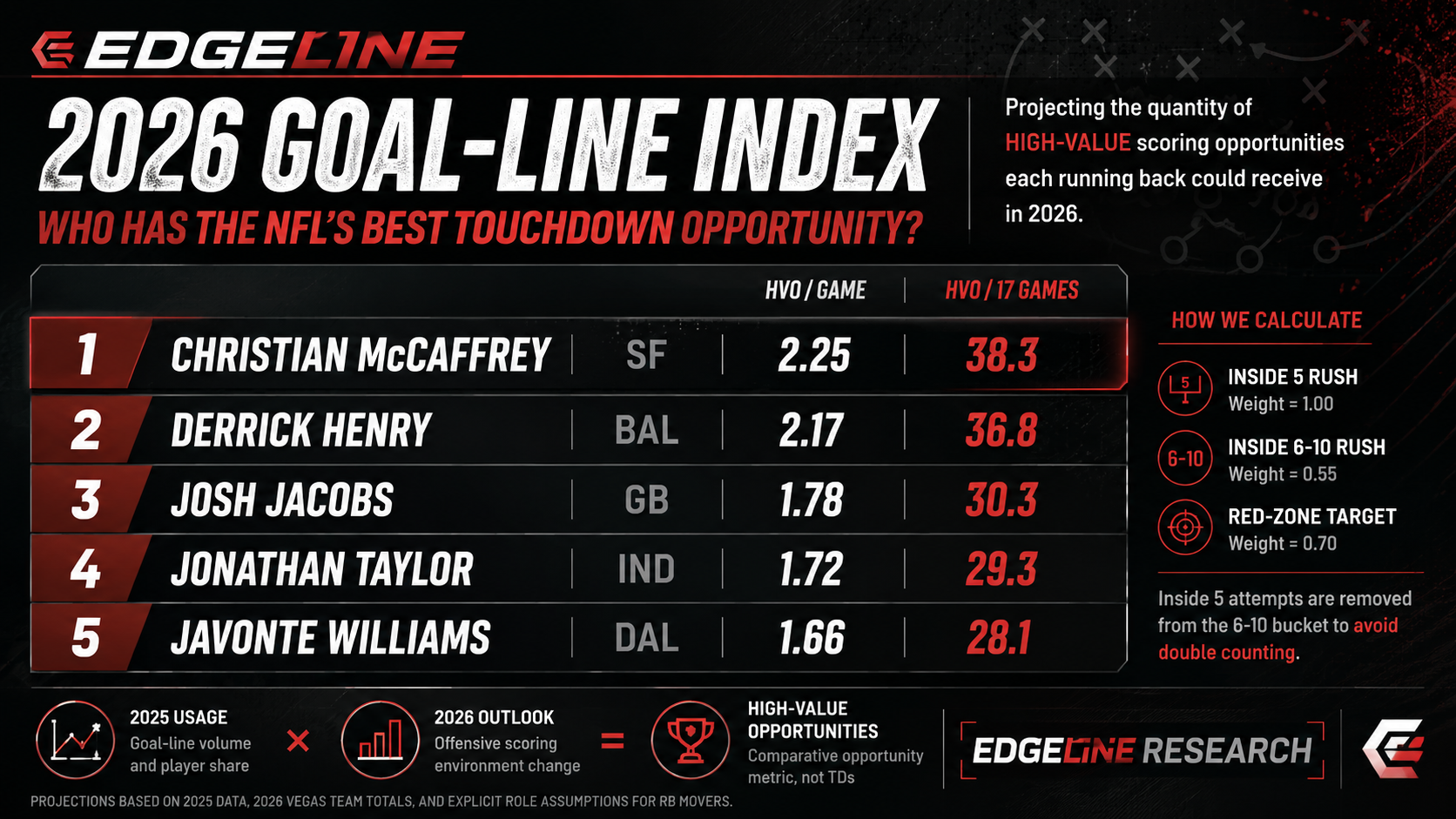
How the EdgeLine Goal-Line Model Works
The 2026 Goal-Line Index
HVO/17 represents projected High-Value Opportunities over a 17-game season. It should be used to compare scoring opportunity, not as a projected touchdown total.
| Rank | Running Back | Team | I5 Share | HVO / Game | HVO / 17 |
|---|---|---|---|---|---|
| 1 | Christian McCaffrey | SF | 76.9% | 2.25 | 38.3 |
| 2 | Derrick Henry | BAL | 84.4% | 2.17 | 36.8 |
| 3 | Josh Jacobs | GB | 74.1% | 1.78 | 30.3 |
| 4 | Jonathan Taylor | IND | 66.7% | 1.72 | 29.3 |
| 5 | Javonte Williams | DAL | 66.7% | 1.66 | 28.1 |
| 6 | Saquon Barkley | PHI | 45.5% | 1.46 | 24.8 |
| 7 | Kareem Hunt | KC | 71.4% | 1.45 | 24.7 |
| 8 | Chase Brown | CIN | 65.0% | 1.44 | 24.6 |
| 9 | Zach Charbonnet | SEA | 67.9% | 1.39 | 23.6 |
| 10 | Kyren Williams | LAR | 56.2% | 1.35 | 22.9 |
Christian McCaffrey Has the Best Overall Scoring Profile
Derrick Henry owns the more dominant pure rushing profile, but McCaffrey's receiving role gives him the broadest path to touchdowns of any back in the study.
McCaffrey controlled 76.9% of San Francisco's inside-five rushing attempts in 2025, while also maintaining significant receiving involvement near the goal line.
Even with San Francisco projected to decline slightly from 25.7 actual points per game in 2025 to 25.0 in 2026, McCaffrey still leads the model at 2.25 High-Value Opportunities per game.
Derrick Henry Remains the Pure Goal-Line King
If this analysis were limited to rushing opportunity, Henry would be No. 1.
He controlled 84.4% of Baltimore's inside-five rushing attempts and projects for roughly 1.65 such carries per game in 2026.
Vegas also expects Baltimore's scoring environment to improve slightly, from 24.9 points per game in 2025 to 25.9 this season.
The only thing keeping Henry behind McCaffrey is receiving usage. Henry essentially offers one touchdown pathway — but it remains an exceptionally valuable one.
Josh Jacobs May Be the Most Interesting Name Near the Top
Jacobs combines an unusually concentrated scoring role with an offense Vegas expects to improve.
He controlled 74.1% of Green Bay's inside-five carries last season, and the Packers move from 23.0 actual points per game to a 24.7-point Vegas projection for 2026.
That combination lifts Jacobs to third in the model at 30.3 projected High-Value Opportunities over 17 games.
Jonathan Taylor's Opportunity Is Elite — But the Offense May Regress
Taylor's underlying role remains excellent.
The reason he falls behind Jacobs is not usage — it's the projected offensive environment.
Indianapolis scored 27.4 points per game in 2025, but Vegas currently projects just 23.4 in 2026. That produces a 0.854 scoring-environment multiplier in the model.
Taylor still ranks fourth overall, but his profile illustrates an important point: even elite goal-line ownership can lose value if the offense simply creates fewer scoring possessions.
Javonte Williams Is the Surprise Top-Five Result
This is exactly the kind of player the model was designed to uncover.
Williams may not carry the same fantasy name value as McCaffrey, Henry or Taylor, but Dallas supplied him with a concentrated high-value role in 2025.
He controlled 66.7% of the Cowboys' inside-five rushing attempts and also contributed as a receiver near the goal line.
Even after adjusting Dallas downward from 27.7 actual PPG to 25.7 projected in 2026, Williams still lands fifth at 28.1 projected HVO over 17 games.
The Most Interesting Contrast: Ashton Jeanty vs. Jahmyr Gibbs
Ashton Jeanty
84.6%Inside-five rushing share
2025 Raiders scoring: 14.2 PPG
2026 Vegas: 19.2 PPG
Projected HVO/17: 20.9
Jahmyr Gibbs
37.0%Inside-five rushing share
2025 Lions scoring: 28.3 PPG
2026 Vegas: 26.1 PPG
Projected HVO/17: 17.5
Jeanty and Gibbs illustrate why this is not an overall fantasy RB ranking.
Gibbs plays in the stronger offense and remains one of football's most explosive backs, but Detroit distributed high-value rushing work across multiple players.
Jeanty controlled an enormous 84.6% of Las Vegas' inside-five carries. The Raiders were one of the league's lowest-scoring offenses in 2025, but Vegas expects meaningful improvement.
Even after capping that improvement at a 25% increase, Jeanty climbs to 12th in the Goal-Line Index.
What About Running Backs on New Teams?
Players who changed teams require more uncertainty.
We do not simply transport a player's old-team goal-line share to his new offense.
Instead, the model uses the new team's historical scoring-zone environment and an explicit projected role assumption.
That matters for players such as Kenneth Walker, Travis Etienne, Rico Dowdle and David Montgomery.
Because those role shares are assumptions rather than established 2026 usage, we treat those projections with less confidence than players returning to the same offense.
The Bottom Line
Touchdowns are volatile.
Opportunity is much easier to study.
McCaffrey and Henry remain in a tier of their own because they combine concentrated goal-line roles with offenses expected to generate plenty of scoring opportunities.
But the more interesting results may come immediately behind them: Josh Jacobs, Javonte Williams and Chase Brown all show strong touchdown-opportunity profiles that aren't simply explained by last year's touchdown totals.
And perhaps most importantly, the model reinforces a simple idea:
Goal-line share matters — but only in the context of how often the offense actually reaches the goal line.